Dawiso Ships a Data Product Platform With Provisioning Built In
Dawiso ships the Data Product Platform, which runs the whole chain in one place: a team defines a data product in a seven-step wizard, publishes it to an internal market, and a consumer who requests it gets the access provisioned in the platform the data live in. The request ends in a permission rather than a ticket, and that permission expires on a date set when it was granted.
“Waiting three weeks for access used to be acceptable, because once you had the data you still had weeks of work ahead of you before it was worth anything. Now you can just talk to your data. Business users have stopped being willing to wait, and what counts as a reasonable wait keeps getting shorter.”Samuel Nagy, VP of Strategic Growth, Dawiso
Why data product projects stop at the description
Data products are not a new idea. They appear in most enterprise data RFPs, teams have been assembling them for years, and Dawiso has shipped a Data Product Catalog of its own since 2023. The argument has moved on from whether to build them.
Two things about building them have stayed hard. The first is the cost of definition: describing a product properly means ports, contracts, quality rules and commercial terms, so the first one usually arrives with a consultant attached and the tenth never gets built.
The second is what happens after publishing. A described product tells a consumer what they could have. Getting it is a separate process in a separate system, with a ticket, an approval chain and, in most organizations, several weeks. The tool that describes the data is rarely the tool that grants the permission.
“You used to request access to individual tables, which never made sense, because you almost always need several of them. Now you request a data product. But it still ends the same way: the request sits in a service desk, someone has to approve it, someone has to provision it, and in a large enterprise that is weeks.”Samuel Nagy, VP of Strategic Growth, Dawiso
Dawiso closes both. Definition becomes a seven-step form a business user can finish, and a request made against a published product ends in an access that actually works.
Seven steps instead of twenty manual ones
The wizard walks the producing team through seven steps. It explains what belongs in each field as it asks for it, which is why the person who understands the data can do this rather than a consultant. Building the same thing by hand means creating four or five object types and wiring the relations between them, around twenty steps.
Owners do not always start from an empty form. Agents that read the technical assets Dawiso has already scanned can draft a whole data product and hand it over, leaving the owner to review and confirm. They also spot a table that has been granted repeatedly over a month and propose promoting it to a data product of its own.
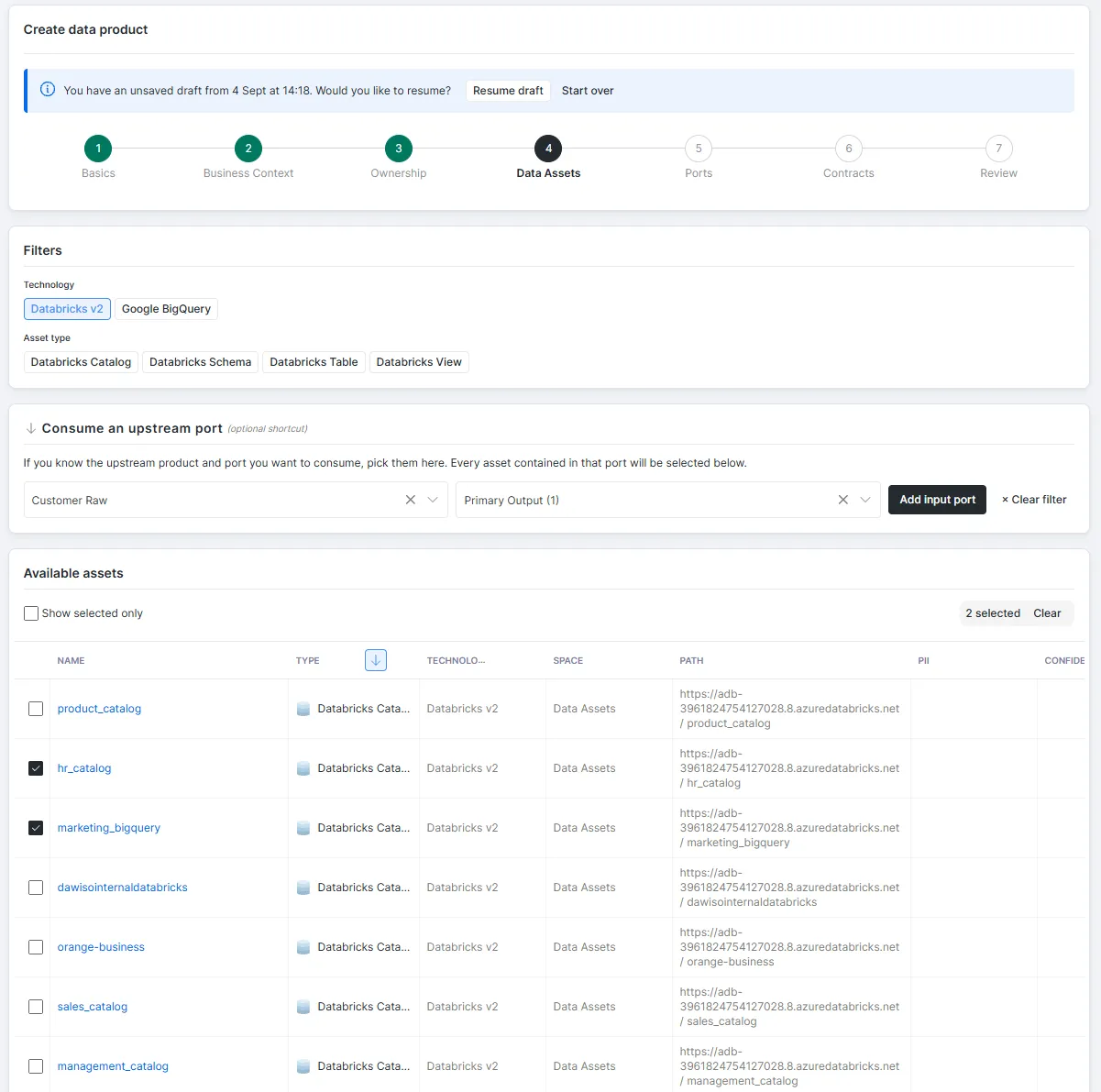
The Data Assets step of the wizard. The steps run from Basics through Ownership and Contracts to Review.
Two of the steps are where the governance actually happens. In Ownership, the product gets a name attached to it, and Dawiso will not publish a product that has none. In Contracts, the producer commits to something a consumer can rely on, for example a refresh by 6am and an error rate under one percent, so the consumer knows what they are taking before they take it.
Neither is optional and neither needs a specialist to fill in. That combination is what moves data products from a program a company runs to something its teams do.
From the cart to the grant
Published products appear in the Data Market, where anyone in the tenant can find them. Between the market and Access Gate sits the Data Cart, which turns browsing into a request with a scope and an end date attached.
A consumer searches, reads what is inside, and checks the contract before committing to it. A refresh at 6am when the report needs data by three is a reason to call the owner rather than to give up, and the owner is named on the product. If the terms fit, the product goes into the Data Cart with the period the consumer needs it for, for example ninety days for a one-off analysis.
Access Gate takes the request from there. It runs the approval, either through the owner of the domain or automatically where the data carry nothing personal or confidential, and then provisions the access in the platform the data live in. It checks what the person already holds, grants only what is missing, and masks a sensitive column such as salary where policy requires it.
“Because the workflows are policy-driven, you can get access to a subset of the data immediately, and it is still secure and still governed. Nobody reaches data they are not supposed to reach. It balances speed against security instead of trading one for the other.”Samuel Nagy, VP of Strategic Growth, Dawiso
Then it does the step most platforms leave out. When the ninety days are up, the access goes away. Permissions granted years ago to people who needed them once are the most common finding in an access audit, and they exist because removing them was always somebody’s job and never anybody’s priority. Here it is a date, set at the moment the access was granted.
Organizations that would rather keep provisioning inside their own process can have Access Gate raise a service ticket instead and track it through to completion.
That last stretch is where the market splits. Data marketplace products run the shop and hand the approved request back to IT to fulfil. Access governance products fulfil requests well but sit apart from the work of defining what is being requested. A company that wants both usually buys both and then owns the integration between them. Dawiso runs the definition, the market and the provisioning on one engine, with the same workflow system, automation rules and API behind all three.
“We run the whole process in one tool. From creating the data product, to publishing it, to someone requesting it, to the access being provisioned. That is why it is actually easy to turn on.”Samuel Nagy, VP of Strategic Growth, Dawiso
Three open standards, nothing proprietary underneath
The model combines three open standards: the Open Data Product Specification, the Bitol Open Data Contract Standard and Data Mesh ports. Every one of its 247 attributes traces back to a published standard, and Dawiso adds no layer of its own.
That matters commercially rather than technically. A customer who describes a thousand data products in Dawiso can export all of them back out, validated against the official schema, so the work stays theirs. See Built on open standards for what each standard contributes.
Availability
Dawiso Data Product Platform is in public preview for customers. Book a demo to watch one product go from an empty wizard to a granted access in your own environment.
See it in action
Data Product Platform
From data product definition to access, provisioning, and compliance evidence, in one platform.
About Dawiso
Dawiso is a data governance platform that gives enterprise data the business meaning people and AI agents need to use it safely. The platform combines the Data Catalog, Business Glossary, Interactive Data Lineage and data products with governed access. Headquartered in Prague, Dawiso serves enterprises globally. Learn more at dawiso.com.
Media Contacts
Webpage: https://www.dawiso.com/
LinkedIn: https://www.linkedin.com/company/dawiso